The California Tax Postponement Program, not Prop 13, Protects Grandma
Seniors who can’t keep up with property taxes have been able to defer them since 1977, a year before Prop 13 passed.
Far and away the most common argument for Prop 13 is that without it low income seniors would be forced to sell their homes. This is a lie and it always has been.
The California Tax Postponement Program has been on the books since 1977 (Prop 13 passed in 1978) and allows “homeowners who are seniors, are blind, or have a disability to defer current-year property taxes on their principal residence if they meet certain criteria”.
The criteria are reasonable: “at least 40 percent equity in the home and an annual household income of $51,762 or less”. This is around the median income for people aged 65+ in California. The limit has been increased over time and is regularly adjusted.
The California Tax Postponement Program does not change the amount of taxes paid to the state. When the owner dies or sells the property the deferred taxes are due. This way low income seniors are not displaced by rising taxes but our schools and parks can continue to function.
While the California Tax Postponement Program is typically left out of conversations about Prop 13 it is understood by people who think deeply about the law. For example, Justice Stevens in the dissenting opinion on Nordlinger v. Hahn writes:
In my opinion, Proposition 13 sweeps too broadly and operates too indiscriminately to “rationally further” the State’s interest in neighborhood preservation. No doubt there are some early purchasers living on fixed or limited incomes who could not afford to pay higher taxes and still maintain their homes. California has enacted special legislation to respond to their plight. Those concerns cannot provide an adequate justification for Proposition 13. A state wide, across the board tax windfall for all property owners and their descendants is no more a “rational” means for protecting this small subgroup than a blanket tax exemption for all taxpayers named Smith would be a rational means to protect a particular taxpayer named Smith who demonstrated difficulty paying her tax bill.
https://www.law.cornell.edu/supct/html/90-1912.ZD.html
The California Tax Postponement Program is rarely taken advantage of with less than ten thousand participants every year. This might be because of Prop 13 but it could just as well be that “getting taxed out of your house” isn’t a legitimate risk on any appreciable scale. Several states provide no such protection and residents do just fine.
Seniors also aren’t the homeowners most squeezed by property taxes. In its 2018 evaluation of the Property Tax Postponement Program, the Legislative Analyst’s Office found that among lower-income homeowners, those in their forties and fifties spend the largest share of their income on property taxes, and the share falls steadily after 65:
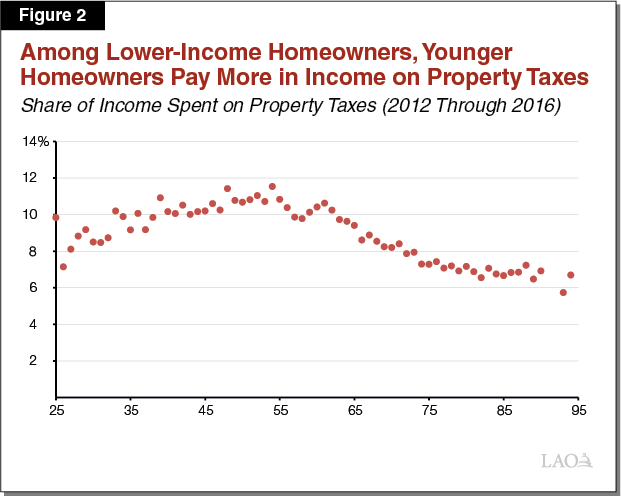
Source: Legislative Analyst’s Office, Evaluation of the Property Tax Postponement Program (October 2018), Figure 2.
In any case, when it comes to housing stability for seniors, Prop 13 is wholly unnecessary.
Corrections and data questions: info@prop13.wtf.